
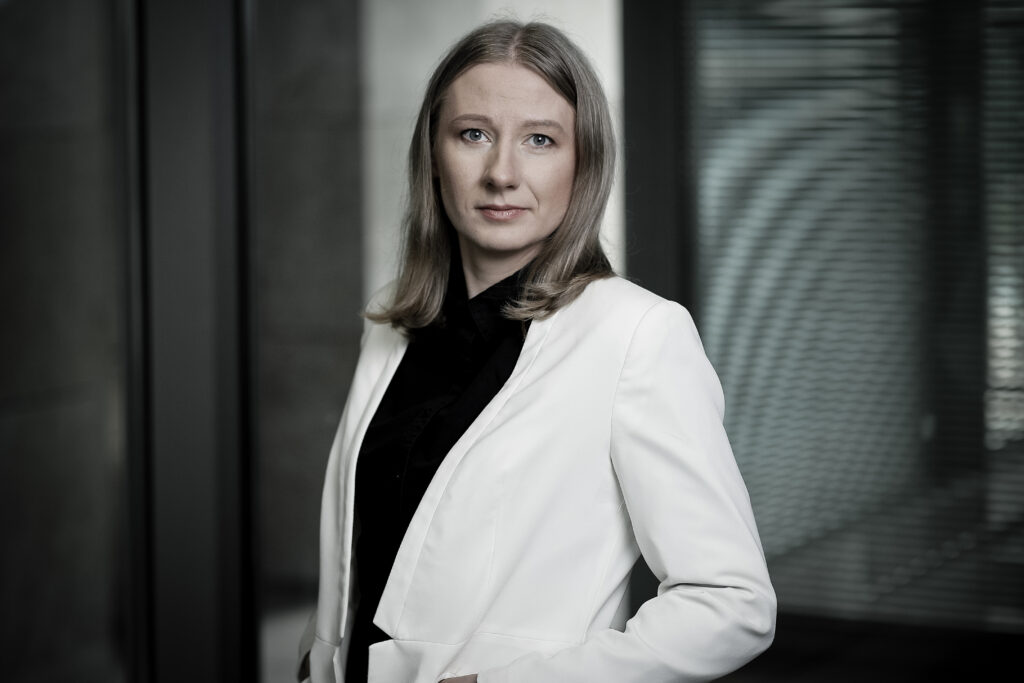
I commenced my journey towards pursuing neurofeedback and alpha-theta waves a long time ago, following the discovery of Brian Tracy’s book “Maksimum Achievement” wherein I discovered that only a small portion of our brain’s potential power is being utilized. I decided to find the answer to the question, “What should we do to use the maximum of our abilities?”
So, the desire to know the human brain’s potential led me to the Faculty of Psychology at the University of Economic and Human Sciences in Warsaw. There I discovered my passion – cognitive neuroscience, and have spent a wonderful time investigating the brain in the Laboratory of Psychophysiology and meeting people who were happy to share their knowledge with me. I still remember that very valuable experience. I then left for my internship to Twente. The result of my investigations there became the basis for my master’s thesis on attention and the SNARC effect.
I have also been working at Jagiellonian University and at the University of Lisbon, investigating the attention span of illiterate people. I also trained my soft skills and learned how to teach at the School of Business and Administration Coaches in Warsaw.
Ive been working as a recruiter for a long time, connecting people to work opportunities and looking for the best choice for both parties – an employer and a potential candidate. I recommend such a job offers, which I would choose for myself. There is no sense for me persuading somebody to buy something I do not believe in.
I have found personal development in such practices as the Lowen method, systemic constellations, and restarting. But the thing that made critical changes in me was the Nelumbo Combo Intensive, led by the Nelumbo Institute.
On the way to my personal development, I discovered that my next step must be providing support to the people on the way to their development through my passion for neuroscience. And I really do it with the help of neurofeedback.
During the 2020–2022, I conducted a seven-day alfa-waves training for the Foundation 108 in Portugal.
In my spare time, I love to visit ancient and early-age architecture as well as interesting corners of wildlife, such as those where I can listen to the sound of the ocean while looking at stars. I like to ice-skate. I enjoy playing board games with my friends.
I follow my heart in my life journey. I meet excellent people on my way, and I am truly grateful for these encounters.
Scientific projects in which I have been participating:
- Neuroimaging of the train reading processes and their pathology in dyslexia.
- Visual attention span and the development of reading skills. Investigation of the adult illiterates population and its contribution to the therapy of reading disorders.
- The productivity of clues and psycho-physiological signs of orientation attention in the SNARC effect (Spatial Numerical Association of Response Codes).
- Comparison of electro-physiological signs of the reaction for the people’s faces and homes, investigations by the method of evoked potentials.
- Dominant hand and the executive attention. Performing of the Stroop test by the right-hand people.
- Investigation of the visual-spatial abilities by the test of mental rotation in right-hand and left-hand people.
- Effectiveness of the context clue in the differentiation of the extent of influence of the noise in perceptual-cognitive tasks.
- Impact of the rise time of the visual stimuli for the time of direct reaction and point of subjective simultaneity.
- Awareness of visual stimuli appearance and awareness of stimuli shape – time differentiality and location of both processes. Investigation with the help of the method of evoked potentials.
- Contribution of the processes of memory and executive attention (conflict monitoring) to the Simon effect.
- Electrophysiological signs of the attention deterioration during the process of aging.
- Relationship between the size of the operation and bioelectrical brain activity in persons with average and extraordinary arithmetic skills.
Publications:
- Sobańska M., Michałowski J.M., Szumska I., Różycka J., Jaśkowski P. (2015). Związek wielkości działań arytmetycznych z aktywnością bioelektryczną mózgu u osób biegłych w wykonywaniu prostych działań arytmetycznych. [Relation between arythmetic operations and bio electrical brain activity in people fluent in simple arithmetic operations]. Studia Psychologiczne, 53, 2, 49-63.